RSS

December 2024 Market Recap

A total of 613 homes were sold in December 2024 via the MLS® System of the Ottawa Real Estate Board (OREB), representing a 7.9% increase from December 2023.

Despite this rise, home sales were 6.8% below the five-year average and 2.7% lower than the 10-year average for December. Year-to-date sales reached 13,526 units by December 2024, an 11.8% increase from the same period in 2023.

“A year of wait-and-see came to a close with the expected slowdown over the holiday season,” said OREB President Paul Czan. “The latter half of the year brought signs of more favourable market conditions with consecutive interest rate drops, higher insured mortgage limits, and extended amortizations. It’s early to assess the impact of these measures. And it’s an uphill battle against affordability and supply issues that persist.”

“Listing activity indicates that sellers anticipate improved conditions could spur more activity from buyers who have been keeping a close eye on the market but hesitant to make moves. Buyers are still limited in their selection of affordable inventory that can meet current demands, which stalls movement. While the improving market conditions are encouraging, the supply needs to be there. Coming political shifts are adding a layer of uncertainty but there is a trending optimism for more increased market activity in the months ahead.”

By the Numbers – Prices

The MLS® Home Price Index (HPI), which tracks price trends more accurately than average or median prices, highlighted the following:

  • The overall MLS® HPI composite benchmark price was $645,800 in December 2024, up 3.8% from December 2023.

    • Single-family homes: $729,300, an increase of 3.7% year-over-year.

    • Townhouse/row units: $533,200, up 11.3% from a year ago.

    • Apartments: $404,400, down 2.5% compared to December 2023.

  • The average sale price in December 2024 was $663,781, a 4.4% increase from December 2023.

  • Year-to-date, the average price was $679,067, rising 1.3% compared to 2023.

  • The total dollar volume of home sales in December 2024 was $406.9 million, up 12.7% year-over-year. For the entire year, the total dollar volume reached $9.2 billion, an increase of 13.3% from 2023.

OREB cautions that while average sale prices offer insight into market trends over time, they do not reflect changes in the value of individual properties. Average price calculations are derived from the total dollar volume of all properties sold, with prices varying significantly by neighbourhood.

By the Numbers – Inventory & New Listings

  • New listings: 603 new residential properties were added in December 2024, marking a 13.6% increase from December 2023. This was 3.5% above the five-year average but 2.7% below the 10-year average for December.

  • Active listings: Residential listings totalled 3,216 units at the end of December 2024, a surge of 58.7% compared to December 2023. Active listings were 90% above the five-year average and 51.4% above the 10-year average for the month.

  • Months of inventory: There were 5.2 months of inventory at the end of December 2024, compared to 3.6 months in December 2023. This metric reflects the time it would take to sell all current inventory at the current sales pace.

Read

Canadian Housing Market 2025: Stability Returns Amid Evolving Lending Rules & Political Changes

In recent years, the Canadian housing market has experienced significant disruptions. A global pandemic, surging interest rates, and economic challenges caused the market to deviate from typical patterns. However, 2025 is anticipated to see a return to conditions more aligned with long-term historical trends.

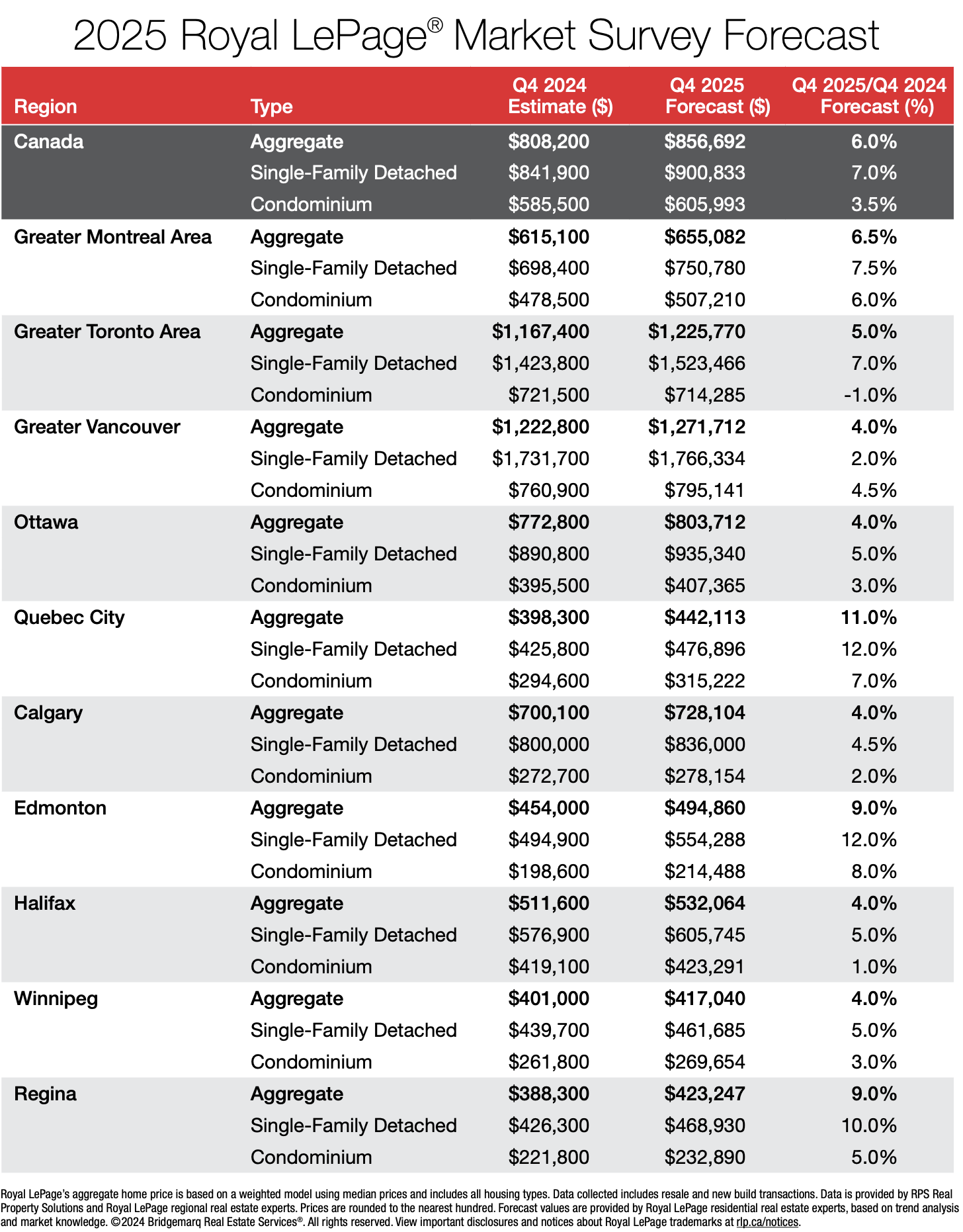
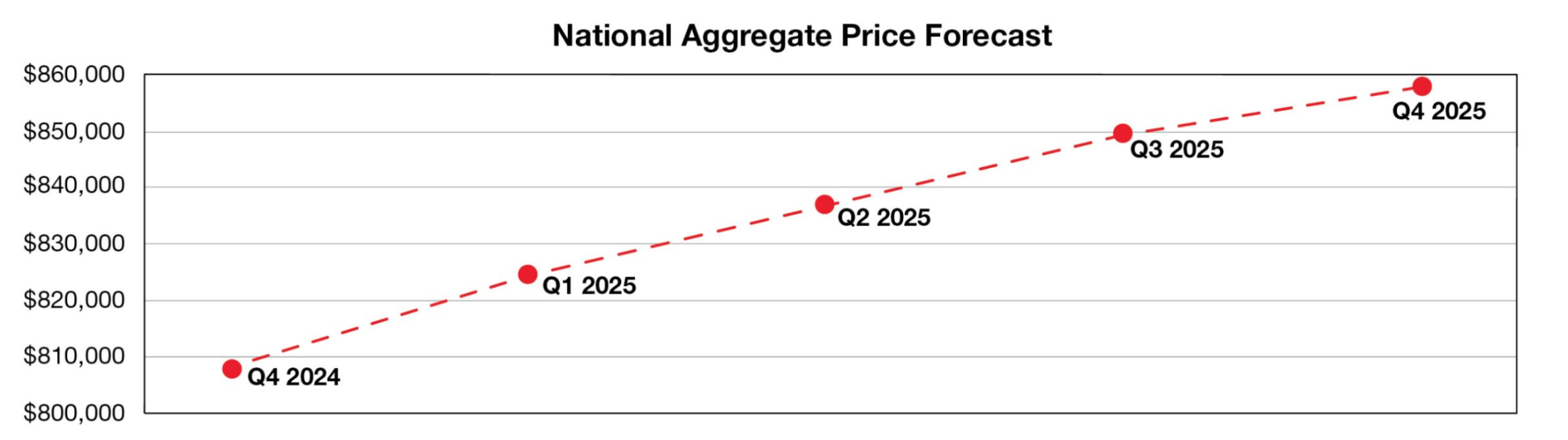
The Royal LePage Market Survey Forecast projects that the aggregate price of a home in Canada will rise by 6.0% year-over-year, reaching $856,692 in the fourth quarter of 2025. The median price of a single-family detached home is expected to grow by 7.0% to $900,833, while condominiums are forecasted to see a 3.5% increase, reaching $605,993.

“After several years of unusual volatility in the real estate market, key indicators point to a return to stability in 2025. The backlog of willing and able buyers continues to grow, and upcoming changes to mortgage lending rules will further enhance Canadians’ borrowing power,” said Phil Soper, president and chief executive officer, Royal LePage. “Most notably, the Bank of Canada’s shift from ‘inflation fighter’ to ‘economy booster’ has taken time to influence buyer behaviour. We saw a marked increase in market activity at the start of the fourth quarter, following the Bank of Canada’s 50-basis-point rate cut. Buyers now believe home prices have hit bottom and are eager to act before competition intensifies.”

New Lending Rules to Enhance Borrowing Power

New lending regulations taking effect this month will provide improved accessibility for first-time buyers and existing homeowners. Starting December 15th, eligibility for 30-year amortizations on insured mortgages will expand to include all first-time buyers and purchasers of new construction homes, an increase from the current 25-year limit. Additionally, the mortgage insurance cap will rise from $1 million to $1.5 million, enabling buyers with less than a 20% down payment to consider higher-value properties. These changes will be especially impactful in Canada’s most expensive real estate markets, where average home prices often exceed $1 million.

“Improved lending conditions, combined with declining interest rates, will unlock new housing opportunities for many Canadians in the new year. First-time buyers will be the primary beneficiaries of these initiatives, as their ability to borrow more for less with a smaller down payment will help bring them closer to their first home purchase,” said Soper. “We believe the return of buyers to the market will encourage builders and trigger a wave of new supply, which is very much needed.

“Addressing Canada’s critical housing shortage must remain a top priority for policymakers at every level of government. With our population growing rapidly through both natural increases and immigration, it is essential to stay focused on supporting the development of new homes if we hope to address housing affordability, be it for purchase or rent.”

Shifting Political Landscapes and Potential Housing Impacts

The year 2025 is expected to bring political changes in both Canada and the United States, with potential implications for the housing market. In Canada, a federal election may introduce new housing policies that could temporarily influence market activity in the latter half of the year.

“With an election approaching in Ottawa and a new administration preparing to take office in Washington, the housing market faces potential disruptions. Here at home, a federal election will see new housing policies that may temporarily impact market activity in the second half of 2025,” said Soper. “Meanwhile, south of the border, the incoming Trump administration’s trade policies and broader economic agenda have the potential to create ripple effects for Canada’s economy and housing market. While these impacts may take time to unfold, they could eventually affect consumer confidence and market dynamics on both sides of the border.”

Highlights from the 2025 Forecast

  • Greater Montreal Area is expected to lead with aggregate home price growth of 6.5%, outpacing Greater Toronto (5.0%) and Vancouver (4.0%).

  • Quebec City is forecasted to see the largest increase among major regions, with an 11.0% rise in aggregate home prices, followed by Edmonton and Regina at 9.0%.

  • Calgary, along with Ottawa, Halifax, and Winnipeg, is projected to experience a moderate 4.0% home price increase, following significant appreciation over the last two years.

  • The median price of a condominium in the Greater Toronto Area is anticipated to decline by 1.0%, reflecting the addition of thousands of new units to an already surplus supply.

Read

Bank of Canada reduces policy rate by 50 basis points to 3.25%

The Bank of Canada today reduced its target for the overnight rate to 3¼%, with the Bank Rate at 3¾% and the deposit rate at 3¼%. The Bank is continuing its policy of balance sheet normalization.

The global economy is evolving largely as expected in the Bank’s October Monetary Policy Report (MPR). In the United States, the economy continues to show broad-based strength, with robust consumption and a solid labour market. US inflation has been holding steady, with some price pressures persisting. In the euro area, recent indicators point to weaker growth. In China, recent policy actions combined with strong exports are supporting growth, but household spending remains subdued. Global financial conditions have eased and the Canadian dollar has depreciated in the face of broad-based strength in the US dollar.

In Canada, the economy grew by 1% in the third quarter, somewhat below the Bank’s October projection, and the fourth quarter also looks weaker than projected. Third-quarter GDP growth was pulled down by business investment, inventories and exports. In contrast, consumer spending and housing activity both picked up, suggesting lower interest rates are beginning to boost household spending. Historical revisions to the National Accounts have increased the level of GDP over the past three years, largely reflecting higher investment and consumption. The unemployment rate rose to 6.8% in November as employment continued to grow more slowly than the labour force. Wage growth showed some signs of easing, but remains elevated relative to productivity.

A number of policy measures have been announced that will affect the outlook for near-term growth and inflation in Canada. Reductions in targeted immigration levels suggest GDP growth next year will be below the Bank’s October forecast. The effects on inflation will likely be more muted, given that lower immigration dampens both demand and supply. Other federal and provincial policies—including a temporary suspension of the GST on some consumer products, one-time payments to individuals, and changes to mortgage rules—will affect the dynamics of demand and inflation. The Bank will look through effects that are temporary and focus on underlying trends to guide its policy decisions.

In addition, the possibility the incoming US administration will impose new tariffs on Canadian exports to the United States has increased uncertainty and clouded the economic outlook.

CPI inflation has been about 2% since the summer, and is expected to average close to the 2% target over the next couple of years. Since October, the upward pressure on inflation from shelter and the downward pressure from goods prices have both moderated as expected. Looking ahead, the GST holiday will temporarily lower inflation but that will be unwound once the GST break ends. Measures of core inflation will help us assess the trend in CPI inflation.

With inflation around 2%, the economy in excess supply, and recent indicators tilted towards softer growth than projected, Governing Council decided to reduce the policy rate by a further 50 basis points to support growth and keep inflation close to the middle of the 1-3% target range. Governing Council has reduced the policy rate substantially since June. Going forward, we will be evaluating the need for further reductions in the policy rate one decision at a time. Our decisions will be guided by incoming information and our assessment of the implications for the inflation outlook. The Bank is committed to maintaining price stability for Canadians by keeping inflation close to the 2% target.

The next scheduled date for announcing the overnight rate target is January 29, 2025.

Source: bankofcanada.ca

Read

Ottawa's Real Estate Market: Spring Surge and Shifting Dynamics

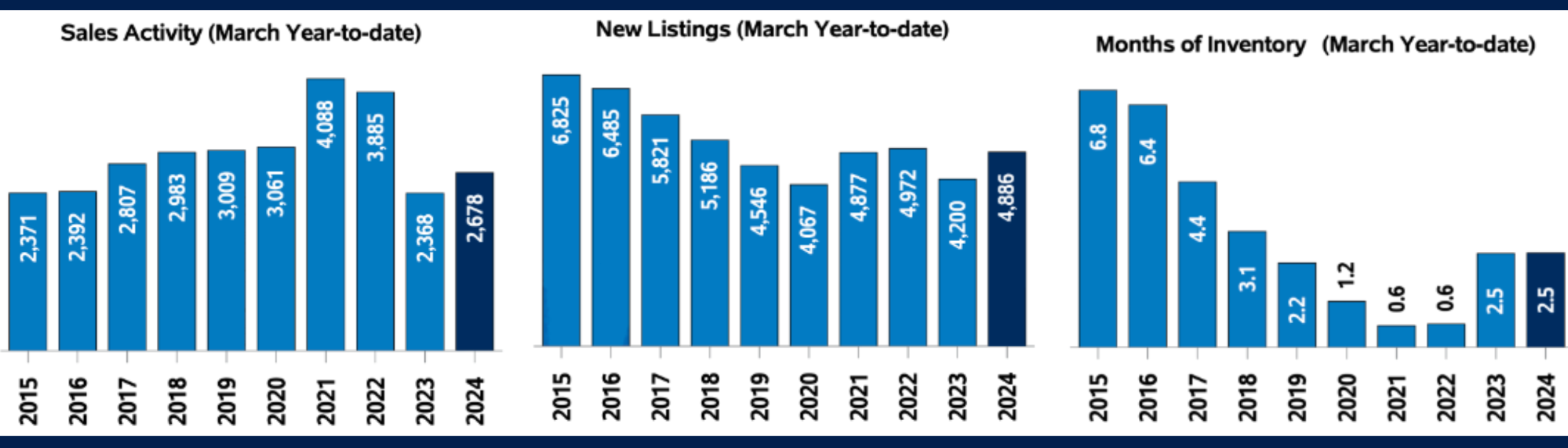
Early signs of a vibrant spring real estate market are evident in Ottawa's MLS® data. In March 2024, the Ottawa Real Estate Board recorded 1,165 home sales, marking a 10% increase from the same period last year. However, despite this surge, sales remained 21.5% below the five-year average and 15% below the ten-year average for March.

Year-to-date figures also depict a positive trend, with 2,678 homes sold in the first three months of 2024, reflecting a 13.1% increase from the corresponding period in 2023. Curtis Fillier, President of OREB, highlights the overall health of Ottawa's real estate market, anticipating an active spring and summer. Fillier notes the growing confidence among sellers, as indicated by the rise in new and active listings, coupled with increased showing activity. However, he observes a cautious approach from buyers, likely due to concerns regarding affordability and limited supply.

Fillier suggests a shift is imminent in the market dynamics, driven by post-pandemic adjustments in housing needs. This includes trends such as downsizing, urban migration, and seeking properties better suited to evolving requirements. Consequently, there's mounting pressure on the mid-range property market in Ottawa, which traditionally faces tight inventory levels. Fillier advises both buyers and sellers not to delay their decisions in this evolving market landscape.

In terms of pricing, the MLS® Home Price Index (HPI) reveals consistent growth. The composite benchmark price reached $636,700 in March 2024, reflecting a 2.7% increase year-over-year. Single-family homes saw a benchmark price rise of 2.6%, reaching $719,000, while townhouse/row units and apartments experienced modest gains as well.

The average price of homes sold in March 2024 was $682,078, up 5.1% from the previous year, with the year-to-date average price showing a 3.2% increase. Overall, the dollar volume of home sales in March 2024 surged by 15.6% compared to the same month in 2023.

In terms of inventory and new listings, March 2024 witnessed a 13.5% increase in new residential listings compared to March 2023, totalling 2,074 new listings. However, this figure remained slightly below the five-year average and significantly lower than the ten-year average for March. Active residential listings also rose by 18.3% year-over-year, with 2,543 units on the market by the end of March 2024. Despite this increase, months of inventory only saw a slight uptick, indicating a persistent imbalance between supply and demand in the Ottawa real estate market.

Take Charge of Your Real Estate Journey Today!

Whether you're looking to buy or sell in Ottawa's dynamic market, now is the time to act. Don't wait on the sidelines as opportunities unfold and market conditions evolve. Reach out and we can guide you through every step of the process. Seize the moment and make your move in Ottawa's buzzing real estate scene!

Read

Bank of Canada Holds Steady: Balancing Inflation and Stability in Economic Policy

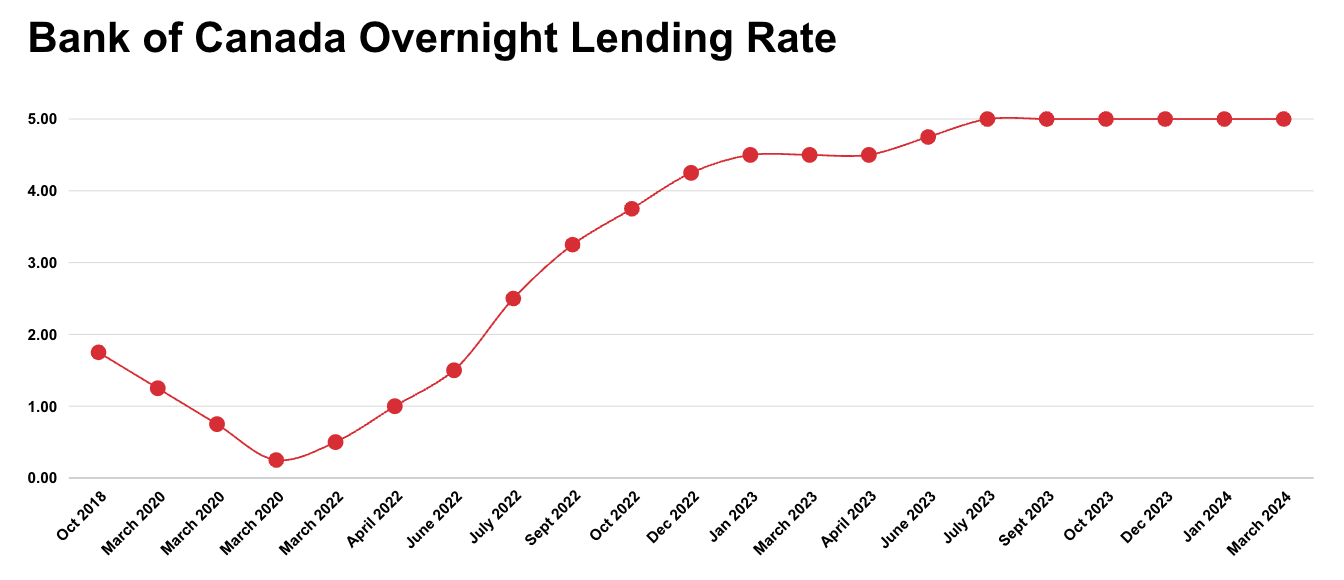
The Bank of Canada has opted to maintain its overnight lending rate at 5% for the fifth consecutive occasion, as announced in its scheduled interest rate declaration on March 6th. It affirmed its commitment to keep the policy rate steady at 5% and to continue the process of normalizing the Bank’s balance sheet.

Despite a drop in the annual inflation rate to 2.9% in January, the Bank cited underlying inflationary factors like shelter costs as grounds for maintaining the current interest rate level. It expressed the desire to witness further easing of inflation and the establishment of price stability before considering rate adjustments.

Economists anticipate potential rate reductions later in the year, possibly in the June announcement, should inflation continue to decrease toward the central bank’s target of 2%. The Bank of Canada's next announcement is scheduled for April 10th, 2024.

Today, the Bank maintained its target for the overnight rate at 5%, with the Bank Rate at 5¼% and the deposit rate at 5%, while also continuing its policy of quantitative tightening.

The global economic landscape saw a slowdown in growth in the fourth quarter, with the US experiencing a slight deceleration but maintaining robust and broad-based GDP growth. Meanwhile, the euro area's economic growth remained stagnant after a contraction in the third quarter. Inflation in both the US and the euro area continued to ease, while bond yields rose and corporate credit spreads narrowed. Equity markets showed strong gains, and global oil prices were slightly higher than previously projected.

In Canada, fourth-quarter GDP growth exceeded expectations, driven by exports, although overall economic growth remained below potential. Despite a modest increase in consumption, final domestic demand contracted, primarily due to a significant decline in business investment. Employment growth continued to lag behind population growth, and there were indications of easing wage pressures. Overall, the data suggest an economy operating with modest excess supply.

CPI inflation eased to 2.9% in January, mainly due to a moderation in goods price inflation. However, shelter price inflation remained elevated and remained the primary contributor to overall inflation. Underlying inflationary pressures persisted, with year-over-year and three-month measures of core inflation remaining in the 3% to 3.5% range. Although the proportion of CPI components growing above 3% declined, it remained above historical averages. The Bank anticipates inflation to stay close to 3% during the first half of the year before gradually easing.

The Governing Council's decision to maintain the policy rate at 5% and continue the normalization of the Bank’s balance sheet reflects concerns about inflation risks, particularly regarding the persistence of underlying inflation. The Council aims to witness further and sustained easing in core inflation while focusing on the balance between demand and supply in the economy, inflation expectations, wage growth, and corporate pricing behavior. The Bank remains steadfast in its commitment to restoring price stability for Canadians.

Read

Frosty Delights & Family Fun: Ottawa's Ultimate Guide to the Family Day Weekend Extravaganza!

Embrace the winter wonderland vibes as we dive into a lineup of frosty festivities and hot happenings in Ottawa! From thrilling bed races to enchanting ice carving demonstrations, our capital city is bursting with cool and captivating events to make your winter weekends sizzle with excitement. Whether you're a sports enthusiast, a culture connoisseur, or just someone looking to spice up their weekends, join us as we unwrap the coolest experiences and hottest happenings in Ottawa this season. Bundle up, grab a hot beverage, and let's embark on a chilly adventure filled with unforgettable moments and winter magic

  1. Winterlude Over the Past Weekend
    Explore the Snowflake Kingdom, a vast winter playground featuring snow slides, a zipline (with paid options), snowboarding and downhill skiing introductions for kids, and an array of other engaging activities – all for free!
    When: Thursdays to Sundays, including Monday, Feb 19. From 9 am.

    Where: Parc Jacques Cartier, 350 Laurier St, Gatineau.

    Winterlude

  2. The Great Canadian Kilt Skate
    Participate in the 10th Annual Great Canadian Kilt Skate in Ottawa. No need to be Scottish or wear a kilt! A similar event will take place in Pembroke on Feb 17, 1-4 pm - free of charge.

    When: Sunday, Feb 18, from 1 pm to 3 pm.

    Where: Lansdowne Park skating court.

    The Great Canadian Kilt Skate

  3. Pibon Winter Festival (Winterlude Edition)

    Celebrate the Family Day Weekend with an Indigenous Makers Market, workshops (some paid), cultural performances, indigenous comfort foods, horse-drawn sleigh rides, and visits to the farm animals, including the Ojibwe Spirit horses.

    When: Saturday, Feb 17, to Monday, Feb 19, from 10 am to 5 pm.

    Where: Madahoki Farm, 4420 West Hunt Club Road.

    Mādahòkì Farm
Indigenous Experiences
Knock on Wood Communications + Events
Friday March 25, 2022

Photo by Ashley Fraser
  4. Accora Village Bed Race

    Enjoy a lively event for teams of all ages where participants decorate their beds and compete in a race. Prizes awarded for the best decorated bed, the fastest bed, and the best fundraisers.

    When: Saturday, Feb 17.

    Where: Dallhousie and York St. Byward Market.

    No photo description available.

  5. Maple Tree Tapping

    Museoparc Vanier invites families to learn about maple syrup production, offering short training sessions on tapping and forest orientation every hour (9 am, 10 am, and 11 am). Bring your snowshoes (optional) - free of charge.

    When: Saturday, Feb 17, from 9 am to 12 pm.

    Where: 320 des Pères Blancs Avenue.

    Maple sugar fans throng to Vanier Muséoparc's revived festival | Ottawa  Citizen

  6. Big Bang Festival

    Experience a unique festival of musical adventures for children and families, with most shows being free and some requiring a nominal fee starting from $5.

    When: Feb 17, 11 am-5:30 pm; Feb 18, 10:30 am-5 pm.

    Where: National Arts Centre, 1 Elgin St.

    BIG BANG Festival | National Arts Centre

  7. PWHL Ottawa vs Minnesota

    Cheer on Ottawa’s professional women's hockey team against Minnesota.

    When: Saturday, Feb 17, at 2 pm.

    Where: TD Place, 1015 Bank St.

    PWHL Minnesota vs. Ottawa | Xcel Energy Center

  8. Ottawa Chinese New Year Fair

    Celebrate the Chinese New Year with dragon dances, traditional handicraft exhibitions, artistic performances, interactive games, and Chinese cuisine - all free of charge.

    When: Sunday, Feb 18, 10 am-4 pm.

    Where: Horticulture Building, Lansdowne Park, Princess Patricia Way.

    RBC CCAO's Ottawa Chinese New Year Fair 加拿大皇家银行中华会馆渥太华春节大庙会Tickets, Sun, 18  Feb 2024 at 10:00 AM | Eventbrite

  9. 7th Annual Harbour Harvest

    Join a family ice fishing derby to raise funds for local charities. Enjoy two rounds of trophies and cash prizes at 11:30 am and 3:30 pm, along with a Pancake breakfast. Tickets: $13, $18, or $47 (family of 4). $20 (at the door).

    When: Saturday, Feb 17, 8 am-3:30 pm.

    Where: Nepean Sailing Club, 3259 Carling Ave, Nepean.

    Harbour Harvest

As we wrap up this frosty journey through Ottawa's winter wonderland, we wish you a Family Day long weekend filled with warmth, joy, and cherished moments with your loved ones. May the laughter echo, the smiles linger, and the winter magic continue to weave its spell on your family time. From thrilling adventures to heartwarming experiences, may this long weekend be a delightful chapter in your winter tale. Happy Family Day, and here's to creating memories that melt away the winter chill and leave you with nothing but warmth and love. Until our next adventure, stay cozy and enjoy every moment!

Read
This website may only be used by consumers that have a bona fide interest in the purchase, sale, or lease of real estate of the type being offered via the website. The data relating to real estate on this website comes in part from the MLS® Reciprocity program of the PropTx MLS®. The data is deemed reliable but is not guaranteed to be accurate.